One way to attract free traffic is to find low competition long tail keywords. This can be particularly effective if there’s a local area within the keyword, such as a town. Despite long tail keywords often getting fewer searches, those searches are more specific, which can mean more “buyer” oriented traffic. Plus, you have a far greater chance of getting a listing on Google with long tail. Shorter tail keywords are more competitive, and so you have less chance of getting found for them on the SERPS – Search Engine Results Pages.
Find Low Competition Long Tail Keywords
To find low competition long tail keywords, use Google’s keyword planner. Type in your main “seed” keyword which relates to your business/website. The keyword planner will give you a bunch of keywords related to your main keyword. At the bottom of this list, you’ll find those which get the fewest searches. These are often the long tail keywords which you have the best chance of ranking for.
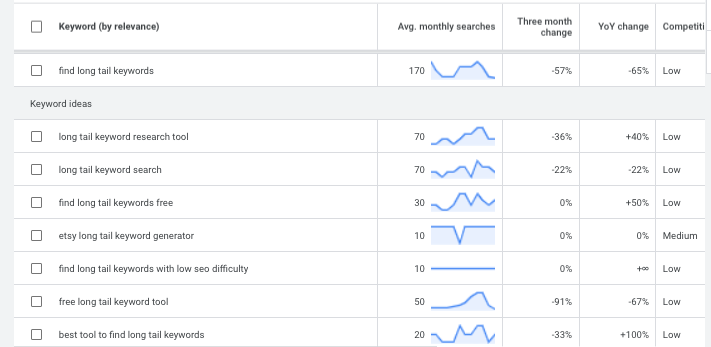
The more terms within your keyword chain, the better. The shorter the phrase is, the harder it generally is to rank for.
Find Low Competition Long Tail Keywords – Ranking For Your Keyword
To find low competition long tail keywords is much easier than to rank for them! Although like I said earlier, if you have a locally based business, and your town/city is within the keyword phrase, it’s easier still. But often there’s still some competition, depending on your niche. So to give your content the best chance of ranking, it’s wise to do a little research before you start writing. Have a look at the top result on Google before you start out. Make a note of how many words have been written in the top ranking article. What other keywords are used for titles?
To rank for your keyword, you’ll need to create a piece of content which Google thinks is worth ranking! So pull out all the stops and make your piece of content really good. If you spend a bit of time on your content and do some good research, you’ll have a greater chance of ranking. Over time, too, you can add to your content making it better and better.
This way, you’ll be creating content which outranks the competition and boosts your authority (in the eyes of Google). If you create high quality content which is “evergreen” your content will compound over time to create more and more “trickles” of traffic. Even if your content doesn’t rank at the top of Google, if you make it good, high quality content, it will boost your website authority; especially if you do this again and again for different keywords.
Choose Buyer Keywords
It’s also worth a mention that it is worth going after buyer keywords more so than “tyre kicker” keywords! A buyer keyword relates to your business and attracts buyers. A “tyre kicker” keyword doesn’t attract buying customers – more likely it attracts freebie seekers! Although some free “giveaways” on your website can help boost your authority, if you spend all your time here, creating free stuff, you won’t attract the buyers through buyer keywords.
Buyer keywords are things such as product descriptions, product reviews and the like. They are the pieces of information which are searched for just before making a buying decision. Free giveaways can attract buyers too, who are looking for some more information, but often they only attract the “browser” not the buyer.
So, an example on this website (of a buyer keyword) would be “SEO packages Leeds“. People looking for SEO packages are likely to have a website and a business. They are seeking to buy something relating to improving the SEO of their website. A “free website audit” might also attract buyers too, but is less of a buyer keyword because it promotes something for free.
Summary
To find low competition long tail keywords start with Google’s keyword planner. There’s other planners too, such as Neil Patel’s tool Ubersuggest. But Google’s is free and you just need an account with Adwords to use it. Type in your main “seed” keyword which relates to your business. Scroll down the list of keywords until you find a long tail one with as many words as possible. These are usually the ones with the least monthly searches.
But a little bit of something is worth more than nothing of a lot! Trying to rank for more competitive keywords is very difficult. Finding low competition long tail keywords and ranking for them is considerably easier. To rank, create high quality content which out-performs the existing content at the top of Google. This might take a but of work but if you start out by creating high quality content which answers each heading well, you’re more likely to rank your content over the longer term.